


Enhancing Your Personal Statement: Expert Personal Statement Editing Tips
Updated: 7 days ago
Writing a personal statement can feel like standing at the edge of a vast ocean, unsure of where to dive in. I remember the first time I sat down to write mine. The pressure to capture my story, my ambitions, and my unique qualities all in one piece was overwhelming. But over time, I learned that the magic often lies not just in writing but in editing. The process of refining, reshaping, and polishing your personal statement can transform it from a rough draft into a compelling narrative that truly resonates.
In this post, I want to share some expert personal statement editing tips that have helped me and countless others. These insights are designed to guide you gently through the editing process, helping you highlight your strengths and present your story with clarity and confidence.
Why Personal Statement Editing Tips Matter
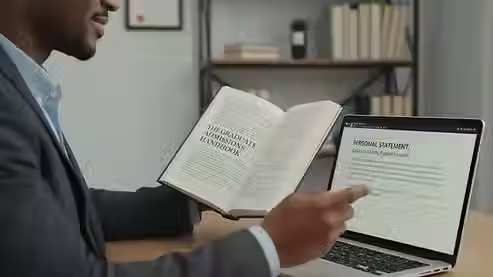
When I first started editing my personal statement, I underestimated how crucial this step was. Writing is just the beginning. Editing is where your ideas become clear, your voice becomes authentic, and your message becomes powerful.
Editing allows you to:
Clarify your message: Remove any confusing or redundant parts.
Enhance your voice: Make sure your personality shines through.
Strengthen your structure: Organize your thoughts logically.
Catch errors: Fix grammar, spelling, and punctuation mistakes.
Tailor your statement: Align your statement with the specific program or institution.
For example, I once had a draft that was full of great experiences but lacked focus. Through editing, I was able to weave those experiences into a cohesive story that showed my growth and passion. This made a huge difference in how my statement was received.
Practical Personal Statement Editing Tips to Try Today
Let’s get into some actionable tips that you can apply right now to enhance your personal statement.
1. Take a Break Before Editing
It’s tempting to jump straight into editing after writing, but stepping away for a day or two can give you fresh eyes. When I do this, I often spot awkward phrasing or unclear ideas that I missed before.
2. Read Aloud
Reading your statement aloud helps catch sentences that don’t flow well or sound unnatural. I like to read mine slowly, almost like telling a story to a friend. If something feels off, I revise it.
3. Focus on Your Opening and Closing
The beginning and end of your statement are your first and last impressions. Make sure your opening grabs attention and your closing leaves a lasting impact. I once rewrote my opening paragraph three times before I felt it truly represented me.
4. Use Active Voice
Active voice makes your writing more direct and engaging. Instead of saying, “I was given the opportunity,” say, “I seized the opportunity.” This small change makes your statement more dynamic.
5. Cut Unnecessary Words
Less is often more. I find that trimming down long sentences and removing filler words makes my writing clearer and more powerful. For example, instead of “I have a strong desire to pursue,” simply say, “I want to pursue.”
6. Check for Consistency
Make sure your tone, tense, and style are consistent throughout. Switching between past and present tense or formal and casual tone can confuse readers.
7. Ask for Feedback
Sometimes, we’re too close to our own writing to see its flaws. I recommend sharing your statement with trusted mentors or peers who can provide honest, constructive feedback.
The Role of Structure in Personal Statement Editing Tips
One of the most overlooked aspects of editing is structure. A well-structured personal statement guides the reader smoothly through your story. Here’s how I approach it:
Introduction: Set the stage with a hook that reflects your motivation.
Body paragraphs: Each should focus on a specific theme or experience that supports your goals.
Conclusion: Tie everything together and reinforce your enthusiasm for the program.
For example, I once reorganized my statement by grouping related experiences together rather than listing them chronologically. This made my narrative more compelling and easier to follow.
Using Transitions
Transitions are the glue that holds your paragraphs together. Words like however, therefore, and in addition help your reader move seamlessly from one idea to the next. I find that adding these small connectors can greatly improve the flow of my statement.

Common Pitfalls to Avoid When Editing Your Personal Statement
Even with the best intentions, it’s easy to fall into certain traps during editing. Here are some pitfalls I’ve learned to watch out for:
Overusing clichés: Phrases like “I have always been passionate” or “since I was a child” can feel generic. Instead, show your passion through specific stories.
Being too vague: Avoid general statements without examples. Instead of saying, “I am a hard worker,” describe a situation where your hard work made a difference.
Ignoring word limits: Admissions committees appreciate concise writing. Respect the word count and make every word count.
Neglecting proofreading: Typos and grammatical errors can distract from your message. Use tools and multiple rounds of proofreading to catch mistakes.
Trying to impress rather than express: Authenticity matters more than fancy vocabulary. Write in your own voice.
Final Thoughts on Personal Statement Editing Tips: Enhancing Your Personal Statement-Expert Personal Statement Editing Tips
Editing your personal statement is a journey of discovery. It’s about uncovering the best version of your story and presenting it with honesty and clarity. I encourage you to approach this process with patience and kindness toward yourself. Remember, every edit brings you closer to a statement that truly reflects who you are and what you aspire to achieve.
If you want more guidance, resources like StatementWritingHelp.com can be a trusted partner in your journey, offering support to craft compelling personal statements that highlight your unique strengths.
Take your time, trust the process, and know that your story deserves to be told beautifully.
I hope these personal statement editing tips inspire you to dive back into your draft with renewed confidence. Your future is waiting, and your personal statement is the key to unlocking it.
Enhancing Your Personal Statement: Expert Personal Statement Editing Tips


Comments